The Real Problem Most Companies Won't Talk About
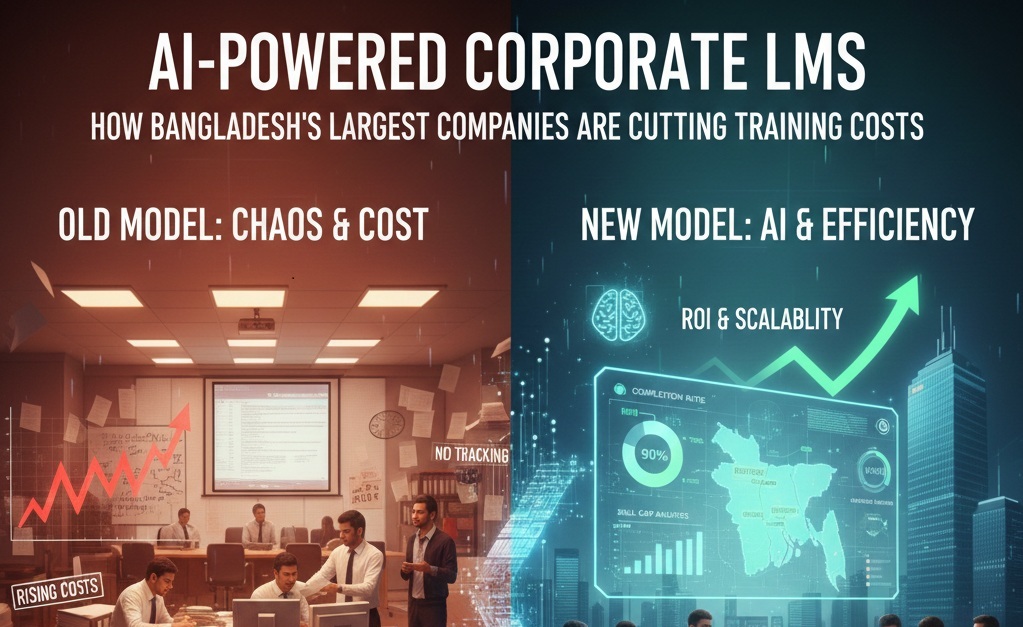
Here's what happens in most large Bangladeshi companies when training time comes around:
HR scrambles to book a venue. Finance questions the trainer's invoice—again. Employees sit through the same presentation they've heard twice before. Meanwhile, the new batch that joined last month? They're still waiting for the next session.
Two months later, nobody remembers if Karim from Accounts actually completed his compliance training. The factory supervisor can't recall which safety module the third shift covered. And when the auditor asks for proof of training completion, someone's digging through Excel sheets from six months ago.
This isn't a training problem. It's a system problem.
And for organizations managing 500 to 1,000+ employees across multiple locations, it's costing more than most balance sheets show.
Why the Old Model Stopped Working
Twenty years ago, corporate training in Bangladesh looked simple: hire a trainer, book a room, print some handouts, call it done.
That model made sense when you had 50 employees in one office. But scale changes everything.
When you're running factories in Gazipur, sales teams in Chittagong, and corporate offices in Dhaka—all hiring new people every month—the training calendar becomes a logistics nightmare. You're not building capability anymore. You're just putting out fires.
👉 Here's what actually happens:
- The same content gets delivered differently every time. Trainer A explains the policy one way. Trainer B contradicts it the next month. Employees end up confused, and managers have no idea what was actually taught.
- Costs keep climbing, but coverage keeps dropping. You're paying per session, per person, per location. The more you grow, the more you spend. And still, someone always misses the training.
- Nobody knows who learned what. Six months after a workshop, can you tell me which employees passed the assessment? Which departments are underperforming? Where the skill gaps actually are? Most companies can't answer these questions without spending a week collecting data.
- The moment you hit 500+ employees, training stops being about learning. It becomes about damage control.
What an AI-Powered LMS Actually Does (Without the Tech Theater)
Let's skip the buzzwords.
- An AI-powered Corporate LMS doesn't replace your trainers with robots. It doesn't magically make bad content good. And it won't fix a culture that doesn't value learning.
- What it does is simple: it removes the operational friction that makes training expensive, slow, and impossible to track. Think of it as shifting training from an event you coordinate to a system that runs on its own.
- Instead of scheduling sessions, employees access training when they need it—morning, night, during breaks, wherever they are.
- Instead of repeating the same content, you create it once and reuse it across every department, location, and future batch.
- Instead of guessing who's trained, you see real-time dashboards showing completion rates, assessment scores, and skill gaps by team.
The AI part?
It runs quietly in the background—analyzing patterns, flagging underperformers, suggesting personalized learning paths—so your HR team isn't drowning in spreadsheets.
Your managers still guide. Your subject experts still create content. Your HR team still sets policy.
The system just stops wasting everyone's time. The Numbers Most Companies Care About
Let's talk cost, because that's where this gets interesting.
For a 1,000-employee organization running traditional training:
- You're paying external trainers BDT 50,000–1,50,000 per session
- Venue, materials, logistics add another 20–30% on top
- Employees lose productive hours sitting in workshops
- You repeat this every quarter, every batch, every new hire
Now multiply that across departments. Across locations. Across compliance requirements. Most finance teams see training as a recurring black hole.
With a centralized LMS:
- Content creation is a one-time cost
- Delivery cost per employee drops to nearly zero
- Training scales without additional expense
- You can measure the return in days, not guesses
- Conservative estimates show 30–50% cost reduction in the first year. But the bigger win isn't what you save—it's what you gain: speed, consistency, and visibility.
Where This Actually Works in Bangladesh
This isn't theory. Large organizations are already doing this. Manufacturing groups use it to push safety training and SOP updates to 2,000+ factory workers without stopping production. When compliance rules change, the update rolls out instantly.
No waiting. No exceptions. No missed shifts.
- FMCG companies train their entire sales force on new product launches in 48 hours—across every district. Field reps get the same knowledge as head office, and managers can see who's actually ready to sell.
- Corporate conglomerates onboard new hires in days instead of weeks. The new accountant in Sylhet gets the same orientation as the one in Dhaka. HR isn't scheduling sessions. They're tracking outcomes.
- The pattern is the same: the larger your team, the faster training becomes a bottleneck. And the faster an LMS becomes non-negotiable.
What Leadership Actually Gets From This
If you're a CEO or CFO reading this, here's what changes:
👉 You stop throwing money at the same problem. Training becomes a controlled infrastructure cost, not a recurring surprise on every P&L.
👉 You see who's capable and who's not—in real time. No more waiting for quarterly reports.
👉 You can spot skill gaps, underperforming teams, and training ROI immediately.
👉You scale faster without breaking things. Opening a new location? Launching a new product? Onboarding 200 people next month? Training doesn't slow you down anymore.
👉 You build institutional knowledge. When your best trainer leaves, their expertise doesn't walk out the door. It stays in the system.
This is why the smartest companies stopped thinking of training as HR's job. They started treating it like IT infrastructure—something you invest in once and leverage forever.
Picking the Right System (The Stuff That Actually Matters)
Most LMS demos look impressive. Lots of features. Fancy dashboards. Nice animations.
Then you deploy it, and nobody uses it.
Here's what actually matters:
- Can you deploy it fast? If implementation takes six months, it's already outdated. You need something that goes live in weeks, not quarters.
- Can it handle your content? You're not buying off-the-shelf courses. You need a system that hosts your SOPs, your policies, your proprietary training—and makes it easy to update.
- Does it show you what you need to see? Reports are useless if they don't answer your questions. You need dashboards that tell you completion rates by department, assessment scores by location, and where skill gaps exist—without digging.
- Will it grow with you? You're not just solving today's problem. You're building a system that works when you hit 2,000 employees, when you expand to another country, when your compliance requirements double.
- The companies that get this right don't shop for software. They choose a partner who understands their operations and can adapt as they scale.
The Bigger Picture: Training as a Growth Engine, Not a Cost Center
Here's the shift that matters most:
- Smart organizations stopped seeing training as something you do when you have time. They see it as the thing that unlocks everything else.
- Your sales team can't execute the new strategy if they don't understand it. Your factory can't improve quality if workers don't know the process. Your managers can't lead if they're never taught how.
Training isn't an expense. It's the foundation of execution.
An AI-powered LMS doesn't just save money. It turns training into something measurable, scalable, and strategic. It gives leadership the data to make better decisions. It gives employees the tools to perform better. And it gives HR the bandwidth to focus on people, not logistics.
For large Bangladeshi companies—and especially those with regional or global ambitions—this isn't a nice-to-have anymore.
It's how you compete.
Quick Answers to the Questions You're Probably Asking
What is a corporate LMS, really?
It's a centralized platform where all your training lives—delivered, tracked, and measured in one place. Think of it as your company's training operating system.How does AI actually help here?
It tracks patterns, flags gaps, personalizes learning paths, and surfaces insights so your team isn't buried in manual reporting. The AI works for you, not instead of you.Is this practical for companies in Bangladesh?
Yes—especially if you're managing hundreds of employees across multiple locations. The larger your team, the faster this pays for itself.Does this replace in-person training
No. It handles the repetitive, scalable stuff so your in-person sessions can focus on what actually needs a trainer in the room.How much does this really save?
Most organizations see 30–50% cost reduction in the first year—but the bigger return is speed, consistency, and the ability to track what's actually working.
Final Thought
The companies that win aren't the ones with the best workshops. They're the ones who build systems that scale, track results, and turn training into a competitive advantage.