Here's something nobody tells you when you're running a mid-sized company: about 70% of automation projects fail to meet their objectives. Not because the technology doesn't work—it usually does—but because companies automate the wrong things, at the wrong time, for the wrong reasons.
I've watched this pattern repeat itself. A company hits 50-150 employees, operations feel chaotic, someone in leadership hears about automation delivering impressive returns, and suddenly there's a rush to "automate everything." Three months later, they've spent significant money on tools that either sit unused or have actually made things worse.
The truth is, automation isn't the answer to most mid-sized companies' problems. Better processes are. And knowing when you actually need automation versus when you just need to fix your broken systems? That's the difference between growth and expensive disappointment.
The Real Automation Trap Nobody Talks About
Most automation failures start with a simple, reasonable-sounding sentence: "Let's automate what we're already doing."
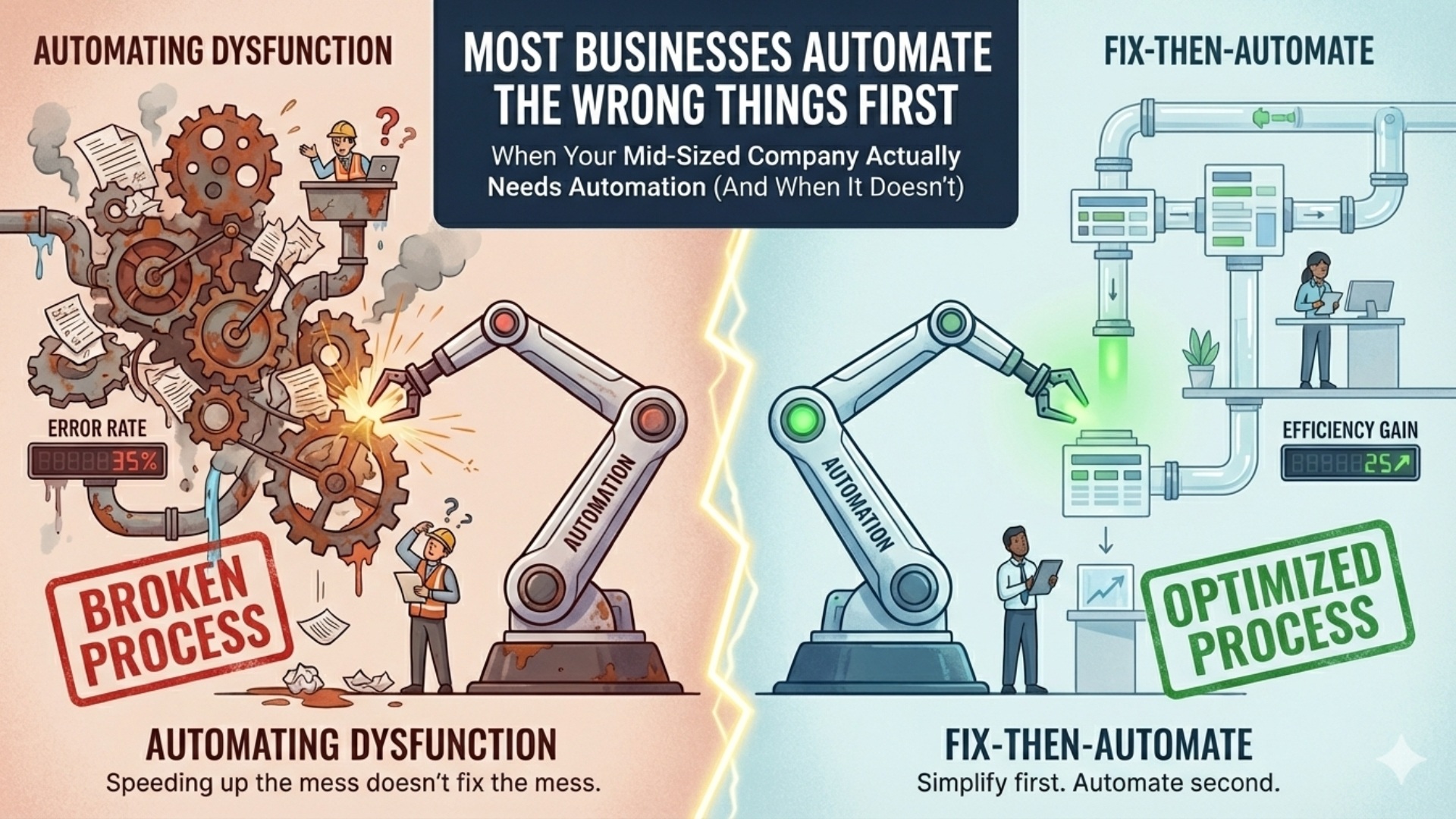
That sentence has probably cost businesses millions. Because here's what actually happens: companies automate broken processes instead of fixing them first, digitizing dysfunction.
Think about it. If your invoice approval process currently takes five people, eight handoffs, and three different email chains to complete, automating it doesn't fix the problem. You've just made a bad process run faster. The real issue—that you probably don't need eight handoffs in the first place—remains untouched.
Organizations implementing RPA have seen ROI improvements ranging from 30% to 200% within the first year, but those numbers only apply when you automate the right processes. The companies hitting 30% ROI? They're usually the ones who automated first and asked questions later. The ones seeing 200%? They fixed their processes first.
When You Don't Need Automation (Even Though Everyone Says You Do)
Let's start with when automation is the wrong answer. Because despite what every software vendor will tell you, there are plenty of situations where mid-sized companies waste money on automation they don't need.
You don't need automation when:
Your process isn't standardized yet. If three different people do the same task three different ways, automation won't help. You'll just end up with an automated mess that nobody can troubleshoot. Fix the variance first, automate later.
The task requires judgment calls. About half of all business processes can be automated, but just because you can doesn't mean you should. Customer service escalations, complex vendor negotiations, hiring decisions—these need human thinking. Automating them typically leads to rigid, frustrating experiences that damage relationships.
Your volume doesn't justify it. Here's a reality check: if a task takes 20 minutes per week, spending six weeks and significant budget to automate it makes no financial sense. The math doesn't work. Your team would be better off just doing the task.
You're still figuring out your business model. Startups and early-stage companies often rush into automation when their processes are still evolving. Then they're stuck maintaining automated systems for workflows that changed three months ago. Wait until things stabilize.
The process fails frequently for unknown reasons. If you don't understand why something breaks, automating it won't magically fix it. You'll just get automated failures. Figure out what's wrong first.
When Automation Actually Makes Sense
Now, here's when automation stops being a buzzword and starts being a legitimate competitive advantage.
You actually need automation when:
The process is genuinely repetitive and rule-based. Invoice processing, order fulfillment, basic data entry—these are perfect candidates. One of the primary indicators that a process is suitable for automation is if it involves repetitive tasks with a well-defined set of rules. If you can write down exactly how it works every single time, you can probably automate it.
You've already optimized the process manually. This is critical. The companies that succeed with automation spend time mapping and improving their processes before they automate anything. They remove unnecessary steps, clarify decision points, and get it working smoothly with humans first.
The volume justifies the investment. As of 2024, approximately 60% of businesses have implemented some form of process automation solution. But the successful ones are automating high-volume tasks where the time savings actually matter. Think hundreds of transactions per month, not dozens.
You can clearly measure the current cost. If you can't quantify how much time and money a process currently consumes, you can't measure whether automation improved anything. Track it manually for a month or two first.
Errors are costing you real money. Human mistakes in data entry, missed steps in workflows, or inconsistent execution leading to compliance issues—these are legitimate reasons to automate. The key word is "costing." Not just annoying, but actually expensive.
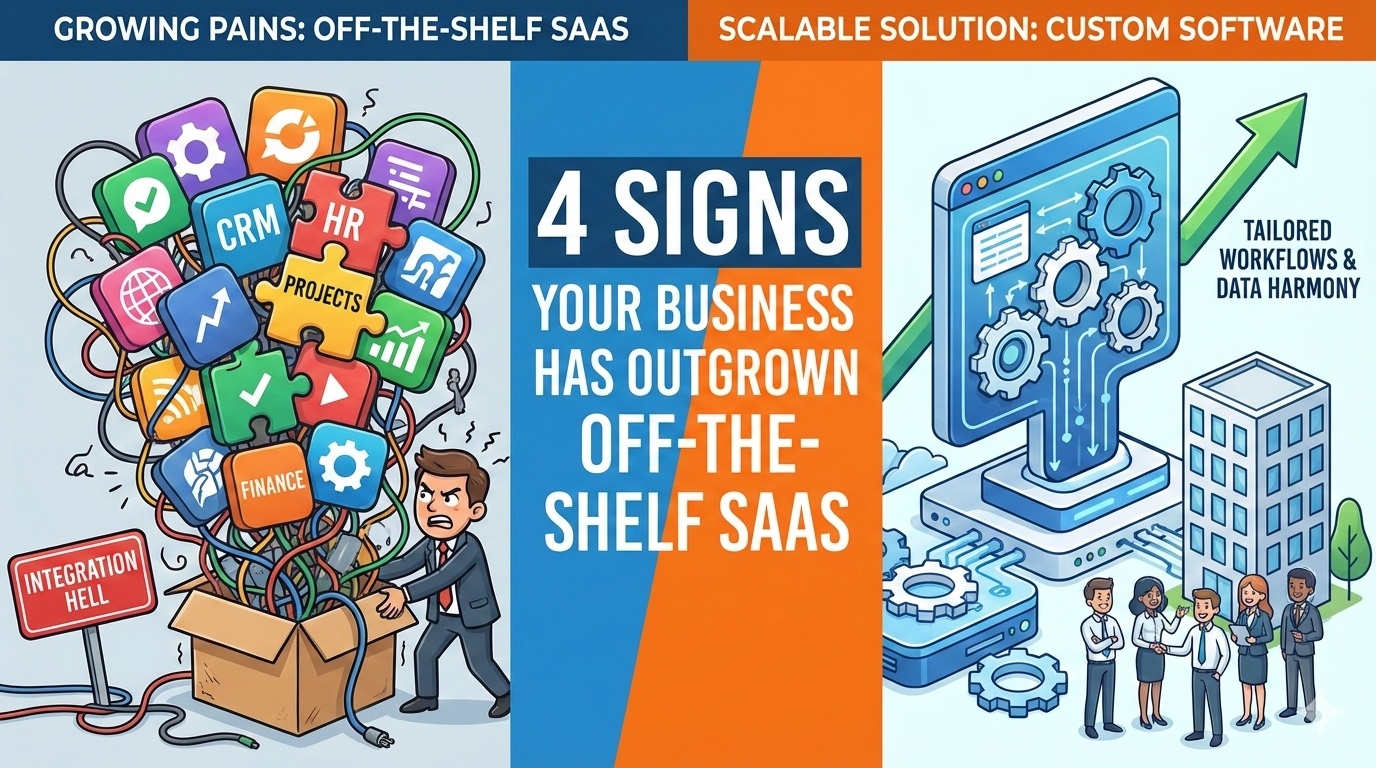
Custom vs. Off-the-Shelf: The Question Nobody Frames Correctly
Here's where mid-sized companies often get stuck: should you buy software or build something custom?
The answer depends on whether your processes are your competitive advantage.
Choose off-the-shelf software when:
Your needs are standard. If you're doing accounting, basic CRM, or project management in ways that look like every other company in your industry, buy software. Don't reinvent the wheel. Companies like QuickBooks, Salesforce, and Monday.com exist because these problems are already solved.
You need it working quickly. Off-the-shelf software can be deployed quickly and is generally less expensive upfront than custom software. If speed matters more than perfect fit, buy something and start using it.
You don't have technical resources. Maintaining custom software requires ongoing technical expertise. If you don't have that in-house or can't afford to hire it, off-the-shelf makes more sense.
Consider custom software when:
Your process is your competitive advantage. If the way you do things is genuinely different and that difference makes you money, custom software might make sense. Custom software provides its users with a competitive advantage through the most efficient, connected, and scalable technology available. But be honest—most mid-sized companies don't have truly unique processes.
Off-the-shelf tools force you to work inefficiently. Sometimes standard software just doesn't fit. But before building custom, make sure you're not just being stubborn about changing your process. The question isn't "can we make the software fit our process?" It's "should we adapt our process to industry standards?"
Integration is critical. If you need tight integration with existing systems and off-the-shelf tools can't connect properly, custom might make sense. But check thoroughly first—modern integration tools can connect almost anything.
You have the budget and timeline. Custom software typically costs more upfront and takes longer to build. Custom software saves you from several additional expenses, such as subscription charges and software license fees, but only if you plan to use it for years. Short-term needs? Buy, don't build.
The Fix-Then-Automate Framework
If you take nothing else from this, remember this sequence:
First, document your current process. Actually write down every step. You'll probably find steps that nobody remembers why they exist. Remove those.
Second, optimize it manually. Get it working smoothly with people doing it. Time it. Measure error rates. Make it as good as it can be without automation.
Third, identify what's truly repetitive. Not the entire process—just the parts that are exactly the same every time.
Fourth, calculate the real costs. How much time does this consume? What do errors cost? What's the cost of delays? Use actual numbers.
Fifth, consider whether automation matches your maturity level. Of businesses with automation, 38% are piloting, 12% are implementing, and 8% are automating at scale. Don't try to jump straight to "at scale" if you haven't piloted successfully first.
Finally, start small. Automate one thing. Measure results. Learn from what goes wrong. Then expand. Companies that try to automate everything at once usually end up with expensive failures.
What Success Actually Looks Like
Successful automation doesn't feel revolutionary. It feels like things just work better.
82% of sales teams report that automation frees them up to focus on building stronger client relationships. That's what you're aiming for—not eliminating people, but giving them time to do work that actually requires human intelligence.
The metric that matters isn't "how many processes did we automate?" It's "did our team get faster, more accurate, and less frustrated?"
Good automation is invisible. People forget they're using it because it just works. Bad automation is visible—people complain about it, work around it, or ignore it entirely.
The Bottom Line
Most mid-sized companies don't need more automation. They need better processes, clearer priorities, and honest conversations about what's actually broken.
Before you automate anything, ask: "If we had unlimited people, would we still do it this way?" If the answer is no, fix the process first.
Automation is powerful, but it's not magic. About 70% of digital transformation and automation projects fail to meet objectives—not because the technology failed, but because companies automated the wrong things.
Stop automating broken processes. Fix them first. Then, if automation still makes sense, you'll have something worth automating.
That's the difference between companies that get ROI from automation and companies that just get expensive software they don't use.