- There's a moment every growing mid-sized company hits. Everything was working fine with your SaaS stack at 30 employees. Then you hit 75, then 120, and suddenly the tools that made you efficient are now making you slower.
Your team is using seven different apps just to complete one workflow. Data lives in three places. Someone asks a simple question about customer behavior, and getting the answer requires exporting spreadsheets from four systems and manually matching columns. The very tools you bought to save time are now costing you time.
This isn't a failure of the technology. It's the natural breaking point that happens when standardized software meets non-standard growth. And it's happening to more companies than you'd think.
The SaaS Promise That Doesn't Scale
SaaS products sold you on a simple pitch: fast setup, low upfront cost, and the ability to scale as you grow. And for early-stage companies, that promise holds up perfectly.
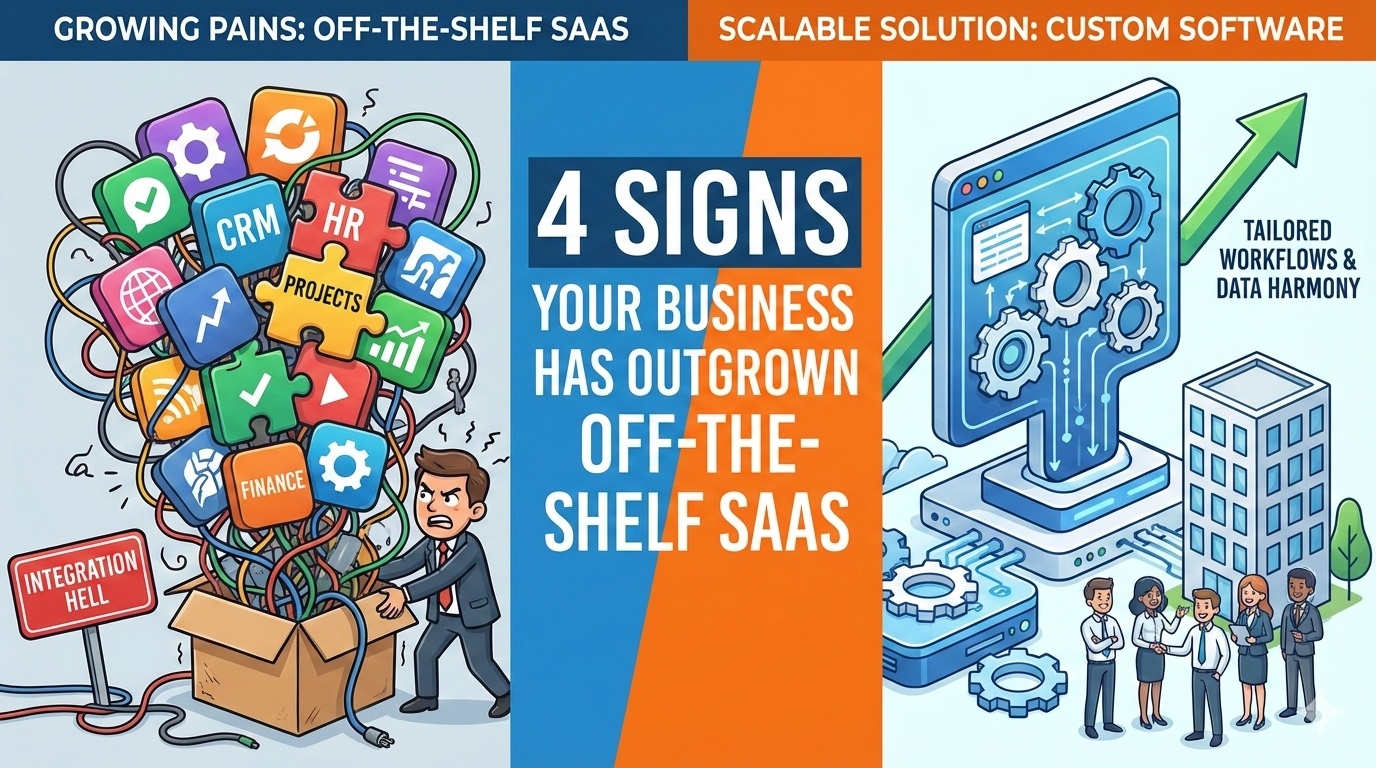
But here's what nobody mentions in the sales demo. Companies today rely on over 250 SaaS applications on average, with each department using between 60 to 80 distinct tools. That's not a tech stack—that's a digital jigsaw puzzle where the pieces don't quite fit together.
The problem isn't that any single tool is bad. Most SaaS products do exactly what they promise. The problem is what happens when you need them to work together, when your processes become more complex, or when you realize your competitive advantage requires doing things differently than everyone else.
The Four Breaking Points That Signal It's Time to Move On
Not every company needs custom software. But there are specific, measurable breaking points where off-the-shelf SaaS stops being helpful and starts being expensive friction.
Breaking Point One: Integration Hell
Nearly 90% of SaaS companies report integration with existing systems as a common or very common sales hurdle. But that's the vendor's problem, right? Wrong. It becomes your problem the moment you have to make these tools work together.
Integration has been cited as the number one sales hurdle for SaaS providers, and it directly translates into lost productivity for buyers. Your team spends more time fighting with tools than using them.
Here's what this looks like in practice. You're running a marketing campaign. Data starts in Google Ads, gets imported to your analytics platform, then exported to your CRM, then someone manually copies it into your project management tool so the team knows what's happening, then finance needs it in a different format for budget tracking.
That's five systems for one workflow. And somewhere in those five handoffs, data gets stale, numbers don't match, and decisions get delayed because nobody's sure which system has the right number.
By 2026, half of all organizations using multiple SaaS applications will move to centralized management because the integration chaos becomes unsustainable. If you're already spending significant time just making your tools talk to each other, you're past the breaking point.
Breaking Point Two: Data Inconsistency and Silos
SaaS applications represent or store data under different formats and models. One tool calls it "customer," another calls it "account," and a third uses "client." They're the same thing, but your systems don't know that.
Many organizations struggle with keeping data consistent across applications in a timely manner. This isn't a minor inconvenience—it's a fundamental business problem.
When your sales team looks at customer data in their CRM and sees different numbers than finance sees in their accounting system, one of two things happens. Either they waste hours reconciling the difference, or they stop trusting the data entirely and make decisions based on gut feeling instead.
Data silos make information hard to access across teams, adding friction to operations and impeding rapid decision-making. In a mid-sized company trying to move quickly, this friction compounds daily.
Breaking Point Three: Your Process Is Your Competitive Advantage
Most SaaS tools are built for the average user. They do common tasks in standard ways. That's fine if you're doing common tasks in standard ways. But if your competitive advantage comes from doing something differently, standardized software becomes a constraint.
About 47% of companies who switched from SaaS to custom development cited better alignment with business processes as the main reason. They weren't rejecting technology—they were rejecting being forced into someone else's process.
Think about it this way. If the way you fulfill orders, manage customer relationships, or deliver your service is genuinely different from your competitors, why would you use the exact same software they use?
Organizations implementing custom solutions report an average ROI of 55% over five years, while SaaS implementations average 42% over the same period. The difference comes from the fact that custom solutions can be optimized for your specific workflow, not a generalized one.
Breaking Point Four: The Cost Curve Inverts
Here's the math that catches companies off guard. SaaS looks cheaper at first because the upfront cost is low. But subscription costs accumulate, ranging from just a few dollars per user per month for basic tools to $450 per user per month for enterprise platforms.
When you're 20 people, that's manageable. When you're 150 people using ten different platforms, you're suddenly spending significant money every month on tools that don't quite fit your needs.
Custom software requires a larger initial investment—projects typically start around $15,000 and increase based on complexity. But once deployed, there are no recurring subscription fees. The software can evolve with your business without renegotiating contracts or upgrading to more expensive tiers.
The crossover point where custom becomes more economical than SaaS typically happens between 50-150 employees, depending on how specialized your needs are. If you're approaching that size and experiencing any of the other breaking points, the math might already favor custom development.
What Actually Happens When You Keep Using the Wrong Tools
Let's be clear about what's at stake. This isn't about inconvenience. It's about measurable business impact.
SaaS companies lose billions in revenue due to integration friction and poor user experiences. But the reverse is also true—buyers lose productivity and growth momentum when they're stuck with tools that don't fit.
Performance bottlenecks emerge. Systems slow down or crash under increased demand. Your tools were designed for companies with standard workflows at moderate scale. You've moved past both.
Security and compliance risks increase. With data scattered across multiple platforms, each with its own security model, you lose control over how information is protected. This becomes especially problematic for companies in regulated industries or those handling sensitive customer data.
Team morale takes a hit. Nobody likes fighting with tools. When talented people spend significant time on workarounds instead of meaningful work, they get frustrated. They also get less effective. The best companies run on efficient processes, and inefficient software creates inefficient processes.
Decision-making slows down. When getting accurate data requires manual exports, reconciliation, and second-guessing, leaders can't make fast decisions. In competitive markets, speed matters. Companies with better data infrastructure make faster decisions and capture opportunities competitors miss.
The Hybrid Approach Nobody Talks About
Here's something most articles skip: you don't have to choose between "all SaaS" and "all custom." The smartest companies use both strategically.
Keep SaaS for commodity functions. Accounting, basic HR, email—these are solved problems. Use proven tools. Don't rebuild what works.
Build custom for differentiation. The workflows that make you unique, the processes that give you competitive advantage, the integrations that SaaS can't handle well—these are candidates for custom development.
About 47% of companies moved from SaaS to custom when they needed better functionality around reporting, automation, and specific business processes. They didn't throw away all their tools. They replaced the ones that were holding them back.
Launch quickly with SaaS, then layer in custom development for unique workflows. This keeps upfront costs manageable while avoiding vendor limitations long-term. It also lets you validate that a process is worth customizing before you invest in building something from scratch.
How to Know It's Actually Time to Switch
Before you commit to custom development, ask yourself these questions honestly.
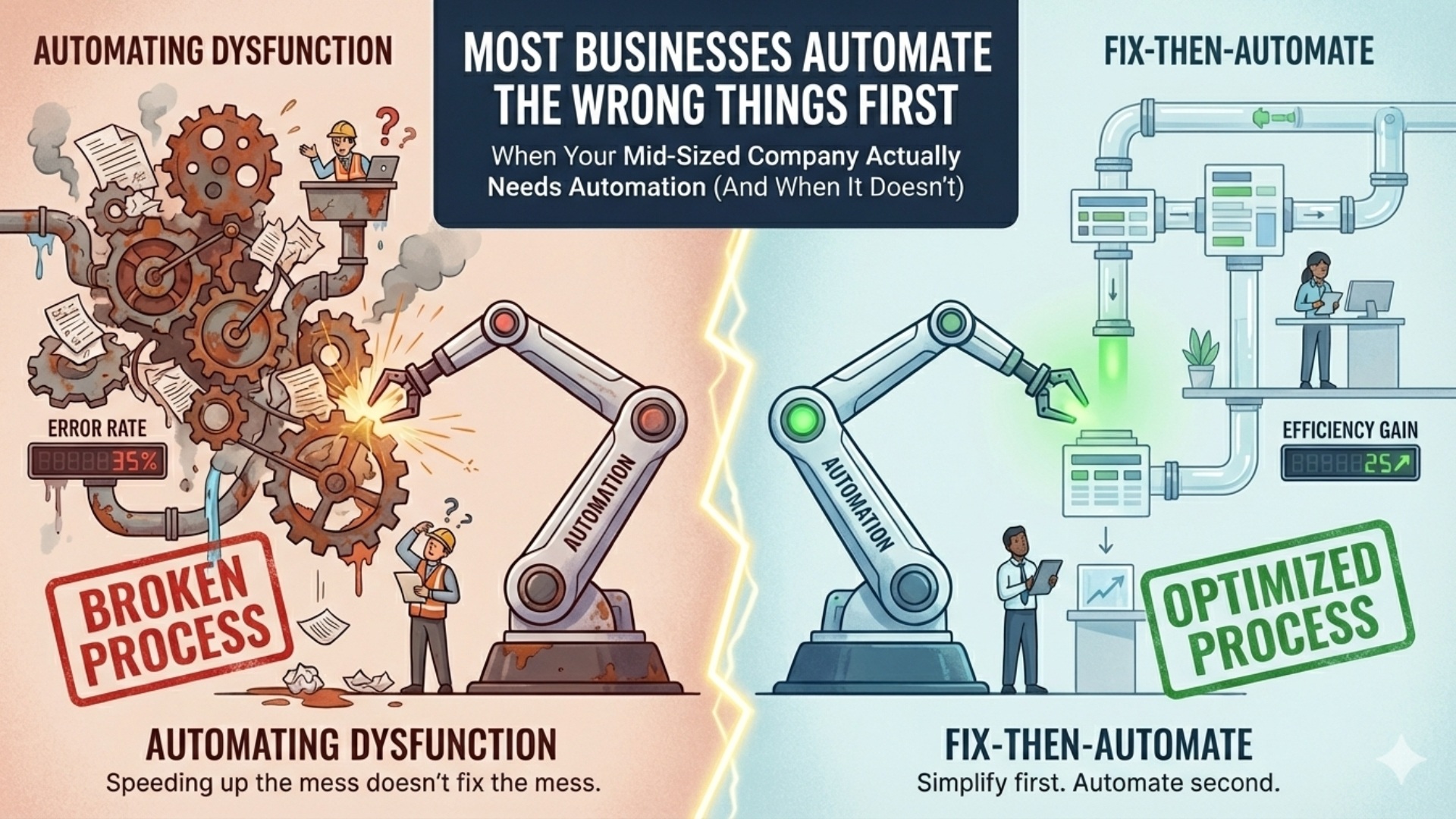
Have you actually optimized your processes first? Sometimes the problem isn't the tool—it's the process. If you automate a bad process with custom software, you just get automated dysfunction. Fix the process first.
Is this workflow genuinely unique to your business? Or are you just stubbornly refusing to adopt industry best practices? Custom software makes sense for true differentiation, not just preference.
Can you quantify the current cost? If you can't measure how much time and money your current setup is wasting, you can't justify the investment in changing it. Track it for a month or two.
Do you have the technical resources to maintain custom software? Building it is one thing. Keeping it running, updated, and secure is another. Make sure you have the capability or budget for ongoing technical support.
Are you truly past 50 employees and experiencing multiple breaking points? Size matters. A 20-person company rarely needs custom software. A 150-person company with complex, unique workflows often does.
The Real Decision Framework
The question isn't "custom or SaaS?" The question is "which problems are worth solving with custom software?"
Choose custom when the process is your competitive advantage, when integration is critical and SaaS can't deliver, when data consistency matters more than the cost to achieve it, and when the five-year total cost of ownership favors building over renting.
Stay with SaaS when the process is standard, when speed to deployment matters more than perfect fit, when you don't have technical resources to maintain custom solutions, and when the workflow might change significantly in the near term.
The companies that get this right don't think in absolutes. They think strategically about which tools enable growth and which tools constrain it. They're ruthlessly practical about keeping what works and replacing what doesn't.
What Success Looks Like
When mid-sized companies make the right choice about custom versus SaaS, it doesn't feel revolutionary. It feels like things finally work the way they should.
Data flows between systems without manual exports. Teams spend time on actual work instead of workarounds. Reports generate automatically with numbers everyone trusts. Decisions happen faster because information is accessible and accurate.
Businesses implementing custom solutions for the right reasons report higher ROI not because the technology is better, but because it's finally aligned with how they actually work. The software serves the business instead of the business serving the software.
That's the real test. If your current tools serve your business well, keep them. But if you find yourself constantly working around limitations, spending more time on integration than innovation, or watching competitors move faster because they have better systems, it might be time to ask whether off-the-shelf is still the right shelf for you.