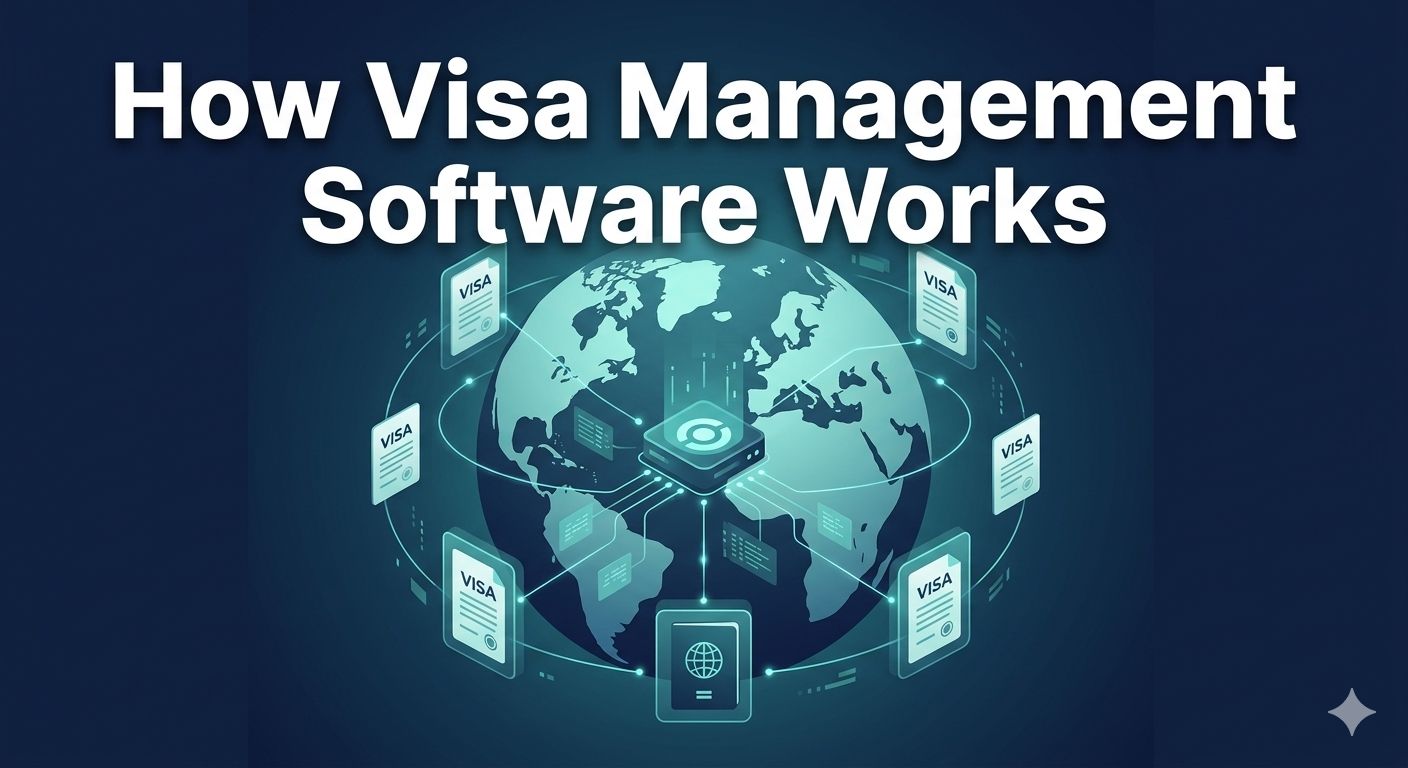
Consular Tech 101: How Modern Visa Management Software Works
Every year, millions of Bangladeshis apply for visas to the United Kingdom, Canada, the United States, Schengen countries, Saudi Arabia, and the UAE. Behind each of those applications is a process — and in most cases, that process still involves someone manually checking documents, typing data into spreadsheets, and sending status updates by phone.
That is changing. Rapidly.
Visa management software — the category of technology built specifically for embassies, consular offices, and immigration consultancies — is transforming how applications are submitted, verified, tracked, and decided. This is what consular technology means in practice, and why it matters for businesses and governments operating in this space.
What Is Visa Management Software?
Visa management software is a digital system that handles the complete lifecycle of a visa application — from intake and document submission through verification, case tracking, compliance checks, and final decision — without requiring manual intervention at every stage.
Think of it as the operating system for a visa consultancy or consular office. Instead of documents arriving by hand, sitting in a physical pile, and being manually checked one by one, a visa management system creates a structured digital workflow where every application moves through defined stages automatically.
The key word is 'automated'. Consular tech does not just digitise manual processes — it eliminates the need to perform many of them at all.
Why the Old Way Breaks Down at Scale
Manual visa processing works when you are handling ten applications a week. It breaks at one hundred. Here is what the failure points look like in a real Dhaka visa consultancy operating without software:
Each of these failure points is solvable with the right consular tech infrastructure. The question is not whether the technology exists — it does. The question is whether the organisation is ready to implement it.
The Core Modules of a Modern Visa Management System
Visa management software is not a single feature — it is a system made up of interconnected modules. Here is what each module does and why it matters:
How AI and Automation Power Modern Consular Tech
The most significant shift in visa management software over the past three years is the integration of AI into the verification layer. This changes not just efficiency but accuracy — and has measurable impact on application approval rates.

OCR and Machine-Readable Zone (MRZ) Parsing
Every modern passport contains a Machine-Readable Zone — the two lines of text at the bottom of the data page. OCR technology reads this zone automatically, extracting the passport holder's name, nationality, date of birth, passport number, and expiry date in under three seconds. The system then cross-checks this data against what the applicant typed in the form — flagging any discrepancy instantly.
Computer Vision Document Validation
AI-powered computer vision systems compare submitted documents against known legitimate templates — checking for the correct holograms, fonts, watermarks, and security features for each country's passport. Forged or tampered documents are flagged automatically before a human consultant sees them, improving both security and efficiency.
Biometric Face Matching
Modern visa software includes liveness detection — a process that captures a live selfie from the applicant and matches it against the passport photo using facial recognition AI. This confirms the applicant is actually the person in the document, with a match typically returned in under two seconds. According to the IATA, 73% of travellers now prefer biometric verification over traditional document checks.
AI Risk Scoring
For higher-volume consular operations, AI risk-scoring models analyse application data against policy rules and historical patterns — generating a risk score that helps prioritise case review. Low-risk applications can be processed quickly; higher-risk cases receive proportionally more human attention. This is how countries like Canada and the UK have reduced backlogs without increasing staff.
Read: How ERP systems integrate with consular tech for enterprise-scale operations
Automated Workflow Triggers
Every stage completion triggers the next automatically. Document upload triggers OCR verification. Verification completion triggers compliance check. Compliance passing triggers consultant review assignment. Decision made triggers applicant notification. Each trigger happens in milliseconds — eliminating the idle time between manual handoffs that accounts for most processing delays in legacy systems.
The Global Context: Why Consular Tech Is a Growing Market
The shift to digital consular services is not just a preference — it is an economic and security necessity. The numbers reflect this:
Sources: MarketIntelo Consular Services Report 2033; Market Research Future E-Visa Market 2024–2035.
For Bangladesh specifically, the stakes are high. Bangladesh is consistently one of the top five remittance-sending countries globally, with millions of workers applying for work visas to the Middle East, Malaysia, and South Korea each year. Add the growing volume of student visa applications to the UK, Canada, and Australia, and Bangladesh represents a significant — and largely underserved — market for modern consular technology.
Most visa consultancies in Dhaka still operate without purpose-built software. The ones that adopt consular tech first gain an immediate advantage: faster processing, lower error rates, and the ability to handle significantly higher volumes without proportional staff increases.
How a Visa Application Flows Through Modern Software: Step by Step
To make this concrete, here is what an end-to-end application journey looks like inside a well-built visa management system. This section maps to HowTo schema — mark each step in your CMS.
Each of these six steps happens within a single connected system — no copying between spreadsheets, no emails to chase up, no manual status calls. The time saved per application is typically 60–75% compared to fully manual processing.
Who Uses Visa Management Software?
Consular technology serves several distinct user types — each with different needs and implementation priorities:
What to Look For in a Visa Management System
Not all visa management software is equal. These are the features that separate genuinely useful systems from glorified digital filing cabinets:

Frequently Asked Questions About Visa Management Software
Q: What is visa management software?
A: Visa management software is a digital system that automates and manages the complete lifecycle of a visa application — from initial submission and document upload through automated verification, case management, compliance checking, and final decision. It replaces manual processes like paper filing, spreadsheet tracking, and phone-based status updates with automated, connected workflows that reduce processing time and error rates significantly.
Q: How does OCR work in visa processing?
A: OCR (Optical Character Recognition) technology scans a submitted passport or identity document and automatically extracts key data — name, date of birth, passport number, nationality, and expiry date — from the Machine-Readable Zone (MRZ) at the bottom of the passport data page. This data is returned in under three seconds with over 99% accuracy, eliminating the need for manual data entry and significantly reducing transcription errors that cause visa rejections.
Q: What is the difference between an eVisa system and visa management software?
A: An eVisa system is a government-operated platform that allows travellers to apply for visas online. Visa management software is the broader category of tools used by embassies, consular offices, and visa consultancies to manage, process, and track applications — whether those come through an eVisa portal or physical submission. Visa management software can integrate with government eVisa systems as a processing back-end or operate independently for private consultancy use.
Q: Is visa management software suitable for small consultancies in Bangladesh?
A: Yes. Modern visa management software is available at different price points — including cloud-based SaaS options with monthly subscriptions that are accessible to small and medium consultancies. Even a Dhaka-based consultancy processing 20–50 applications per month can benefit significantly from document management, OCR, and automated notifications. The ROI comes from reduced consultant time per application and fewer rejection rates due to document errors.
Q: What security standards should visa management software meet?
A: Visa management software handles sensitive personal data including passport copies, financial records, and biometric information. Key security standards include: AES-256 encryption for data at rest, TLS 1.3 for data in transit, role-based access control, full audit logging of every action, GDPR compliance for European applicant data, and regular penetration testing. Systems built for government use additionally require compliance with national data protection regulations.
Q: How does biometric verification work in consular technology?
A: Biometric verification in consular tech typically involves two components: facial recognition and fingerprint scanning. In the application process, facial recognition compares a live selfie or photo submitted by the applicant against their passport photograph. This liveness check confirms the person is genuine and prevents identity fraud. Fingerprint data is captured at physical visa application centres and stored against the applicant's record. Both are matched against government databases during processing.
Q: Can visa management software integrate with existing embassy systems?
A: Yes, modern visa management software is built with API integration capabilities that allow it to connect to government databases, airline reservation systems, border control systems, and national ID registries. The extent of integration depends on the system's architecture and the government's data-sharing policies. Custom-built consular tech solutions can be designed specifically to interface with existing infrastructure — which is an area where purpose-built software outperforms off-the-shelf products.
What to Read Next
These posts go deeper into the topics introduced in this guide: